Once Upon a Time in the West (1966); Director: Sergio Leone; rated PG-13 for Western violence Screenplay: Gergio Donati, Sergio Leone; Cinematography: Tonino Delli Colli; Editing: Nino Baragli; Music: Ennio Morricone Starring: Claudia Cardinale (Jill McBain), Henry Fonda (Frank), Jason Robarbs (Cheyenne Gutierrez), Charles Bronson ("Harmonica"), Woody Strode (Stony), Cabriele Ferzetti (Mr. Morton), Paolo Stoppa (Sam), Keenan Wynn (Sheriff of Flagstone), Jack Elam (Snaky) Plot Summary: Jill McBain, a former prostitute turned landowner, arrives in the frontier town of Flagstone only to find her new husband and his children murdered. A ruthless assassin, Frank, working for railroad baron Morton, is responsible for the murders and has framed the bandit Cheyenne. A mysterious man, known only as Harmonica, also arrives seeking revenge against Frank. Jill, Cheyenne, and Harmonica form an uneasy alliance as they attempt to hold onto the valuable land that Morton wants for his railroad.
The importance of a film's opening scene cannot be overstated. It sets the mood. It grabs the audience. It introduces a main character. If you blow it, many won't stay around for the rest. This Western's opening takes its time and is iconic. In the wide open Western expanse, there are three silent, stoic gunmen waiting for a train to arrive. Shot completely without music, we hear the windmill's creak, the buzz of a fly, the drip of water, and every grunt. The train platform is a cobbled-together mass of railroad ties that silently screams authenticity. The train arrives, the gunfighters approach it. In a burst of steam, it stops. We see no one exit, the whistle blows and it pulls slowly away... then we hear it - the harmonica. The metal device wails its slow, memorable tune. The gunfighters freeze, then turn to face a sun-hardened man in a shabby hat. His blue, close-set eyes are like steel. He appears chiseled out of granite. The man asks for Frank. Words are exchanged, then guns are drawn. Everyone falls in the exchange, but only one survives. Something subtle you might have missed: cameos Italian director Sergio Leone's first successful Westerns featured only one American cast member, notably Clint Eastwood. This film was produced by Paramount Pictures and thus features a wider array of American actors including Henry Fonda, Jason Robards, Woody Strode, Jack Elam, Keenan Wynne, Lionel Stander, and the film's lead in Charles Bronson. Surprisingly, the addition of American actors did not help overcome the over-edited version of the film made for American audiences. It was initially deemed a flop in the U.S. Memorable Quotes: "He's whittlin' on a piece of wood. I've got a feeling when he stops whittlin'... Somethin's gonna happen." - Cheyenne "People scare better when they're dyin'."- Frank "Inside the men, there were three bullets."- Harmonica "You don't understand, Jill. People like that have something inside... something to do with death."- Cheyenne Dad's Review: For years I avoided the Italian Westerns (later to be known as "Spaghetti Westerns"). As a lover of the classics in the genre, I just could not buy these oaters filmed in Italy, helmed by an Italian director, and littered with bad voice-over dubbing. As I have said in many cases, I was just not ready to "receive the genius". Yet, I gave this film a chance for one reason, my love of Charles Bronson. After the film's opening scene, I was hooked. After several viewings throughout the years, I now see that this epic American revisionist Western story is grandly told and features a wonderful combination of surprises and the inclusion of classic Western archetypes.
The back story for this Western tale of revenge is a former prostitute whose new family is brutally murdered on the very ranch to which she is en route. Her husband and his three red-headed children lie dead. Jill McBain, the man's wife for only a month, seeks to find the those responsible. What she does not know is that her husband was murdered as part of a plot to steal her husband's land, which includes the new town of Sweetwater. Why? The hamlet lies in the future railroad's path. Jill, the surviving widow, is now the sole new owner of the town. By sheer luck, she finds two allies in Cheyenne, a known fugitive, and Harmonica, a mysterious man at odds with those set on buying Jill's land on the cheap. Through it all, Jill remains a beacon of strength. Italian grit There's one thing consistent about all spaghetti Westerns, they are gritty and grungy. The men are sweaty and their clothes reflective of that fact. They act bad for the most part, and that includes treating women with scorn. The bad guys are cold-blooded killers who laugh as they shoot you right between the eyes. They have henchmen aplenty. The good guys? Well, they're bad, too, just not as bad. However, they do live by the Western code, which protects innocents while, blasting the villains. There's lots of drinking and fighting in the dusty town streets and vast Italian landscapes. epic in scope What most impresses me with Leone's work is that although much of this film is intimate, there are huge moments that show the grandeur of the West. In this film, there are two such moments. First there is a shot that pans back from our heroine standing in the dirty street. As the camera moves back, the bigger scene explodes with movement, every person a part of a city growing right before our eyes. It really is breath-taking, especially in a time before drones. Just pulling off that one scene must have taken days to film. The second is Frank's final encounter with Harmonica. The scene is set where hundreds of Mexican workers are using picks and shovels to clear a path for the new railroad. There is a rhythmic beauty to the implements rising and falling, sometimes in unison, sometimes not. Slowly Frank, dressed in all black, rides his horse along the track. It is an epic, awesome scene set to an incredible musical score. the morricone effect Ennio Morricone was a regular composer on Leone's films. His sound became synonymous with all Italian Westerns. Not only was he able to bring the big, grand splendor required for some of the most epic scenes, but he was a master at creating leitmotifs, which are short ditties related to each of the main characters. I'm sure you can hear the distinctive tune played for Eastwood's nameless character in The Good, The Bad and the Ugly (1966). Here, we instantly recognize Harmonica's howling tune, a symbol of the coming justice. We also hear Jill's haunting, yet inspiring, theme (a lovely, operatic set of notes sung wordlessly by Edda Dell'Orso). Without Mr. Morricone, these films would not be the same.
Hollywood liked its heroic Western actors. Three men usually played the good guys: John Wayne, James Stewart, and Henry Fonda. In what would eventually be hailed as a stroke of genius, Sergio Leone cast Fonda as Frank, a ruthless man, willing to do anything for money and power. How ruthless is he? Within ten minutes he murders three children. Damn. His cold eyes instantly transformed into murderous blue orbs. His portrayal is actually quite scary. the round up This film certainly had its early critics. It's too long. Its plot is hard to follow. Yet, as time has moved on, they now call Once Upon a Time in the West a "masterpiece" or "one of the greatest movies every made." Many directors, such as Martin Scorsese, George Lucas and Quentin Tarantino, have stated it is a film that influenced their filmmaking. It is on more than a few Top Film lists, including mine. El Fin On to No. 92... Madam Uncertainty Pyre
|



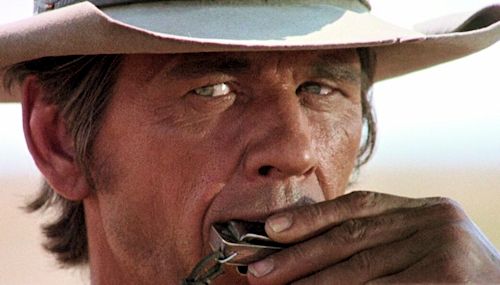 Defining Moment:
starting with a bang
Defining Moment:
starting with a bang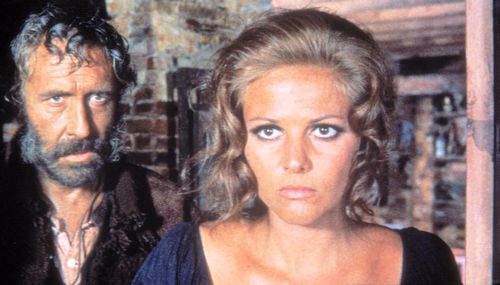 a
woman's story
a
woman's story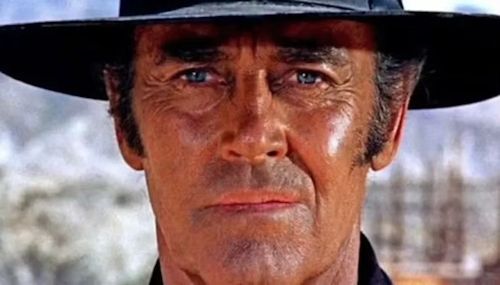 unlikely
casting of the villain
unlikely
casting of the villain