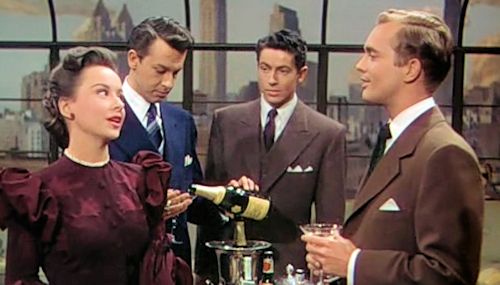
Rope (1948), DML Rating: ★★★★★★★★★★ - perfect Director: Alfred Hitchcock; Screenwriter: Arthur Larents; Story: Hume Cronyn; rated PG Starring: James Stewart (Rupert), John Dall (Brandon), Farley Granger (Phillip), Joan Chandler (Janet), Sir Cedric Hardwicke (Mr. Kentley), Constance Collier (Mrs. Atwater), Kenneth Lawrence (Douglas, Edith Evanson (Mrs. Wilson) Plot Summary: Two intellectual young men, Brandon and Phillip, murder a former classmate as an act to prove their supposed superiority. They then host a dinner party, with the victim's body hidden in a chest within the same room, serving as a macabre challenge to mental acuity. As the evening unfolds, their former professor, Rupert, becomes increasingly suspicious at their odd behavior. Defining Moment: the cigarette case Brandon and Phillip's unusually tense dinner party winds down, thanks in part to concerns that Mr. Kentley's son David appears to have not reached his travel destination. The departing guests are given their coats and hats. Mr. Kentley is given a set of books bound by the infamous rope used in the murder. When all guests and the maid are gone, the two perpetrators are elated that they have pulled off quite a daring and macabre event. To their surprise, Rupert, their old college professor, returns noting that he had forgotten his cigarette case. The bold pair invite Rupert to have a drink before leaving. He who suspects something amiss, then presses them regarding David's curious disappearance... then he pulls the rope out of his jacket pocket. The mere sight of it sends the intoxicated Phillip over the edge. Something subtle you might have missed: one take The boldest part of this Hitchcock film was his desire structure it, start to finish, in one take, much like a one-act play. Making a film in one continuous take is near impossible. The decision was made to create ten separate segments. The trick, to give the illusion of a single take, would be accomplished by having an actor walk in front of the camera causing blackness. The film would then be cut to the next segment, which would begin in blackness. It appears that the action is merely the next instant, not a cut that could be shot on a different day for instance. This required an increased attention to continuity, but it does work here flawlessly.
"After all, murder is - or should be - an art. Not one of the 'seven lively', perhaps, but an art nevertheless. And, as such, the privilege of committing it should be reserved for those few who are really superior individuals."- Rupert "I've always wished for more artistic talent. Well, murder can be an art, too. The power to kill can be just as satisfying as the power to create." - Brandon "At times, your sense of humor is a little too malicious, chum." - Janet, to Brandon "And you've thrown my own words right back in my face, Brandon. You were right, too. If nothing else, a man should stand by his words. But you've given my words a meaning that i never dreamed of!" - Rupert Dad's Review: Selecting a film from Hitchcock's filmography was a daunting task for me. Yes, I am a fan. Hitch was a genius at building suspense within the human condition. He loved to give the audience clues that the characters do not see. Then, he would deny the audience enough information to judge with certainty. I could easily have picked some of his more popular films: North By Northwest (1959), Rear Window (1954), Vertigo (1958), The Birds (1963). For me, coming in second is the glorious Notorious (1946) - that film is truly amazing. So why Rope? I love its genius within simplicity. It all takes place in one evening. There are no chases, no gun battles. It is so unusual to have the murder occur in the first five seconds of a film. We see it. We see who does it. What is the mystery? Yet, through the film's informative, well-written dialog, we are slowly given facts that paint in the story regarding the very thing that opened the film. The point of this mystery masterstroke is the telling of a story - how arrogance clouds sound decisions, how little inconsistencies have meaning.
Knowing this only makes Rope more interesting. Another interesting trait of Leopold and Loeb was their relationship. They were gay men. The play on which the film was based portrayed them as openly gay, however Hitchcock knew that that would never get past the censors in 1947. So he wisely made the film and never mentioned the character's homosexuality. All this with the film's screenwriter, Arthur Laurents, involved in a relationship with the film's bisexual star Farley Granger. Additionally, everyone knew that star John Dall was gay. As I watch Rope now, I see the sexual undertones everywhere, yet, somehow, the Hayes code censors missed it. The film was approved. And here we are. There are several scenes in Rope worth noting. Rupert and the house maid, Mrs. Wilson, are at the wooden chest involved in a discussion. She's more than willing to discuss the oddity of serving the food from this article of furniture, since they have a buffet table for that purpose. The camera fades back from them until we can no longer hear their conversation. Phillip comes in view directly in front of the shot. Upon seeing the two conversing, he turns as if to call out to Brandon, but decides against it. You can see the panic in his face. Clearly his conscious regarding the matter, and an extreme fear of getting caught, is eating away, edging him closer to the breaking point. That is suspense-building 101.
Finally, I must single out the film's conclusion. By this time, we are exhausted, as is Rupert. No more questions. No more lies. He knows they have done something to David, and he must look inside the chest to confirm it. He opens the large lid and it obscures the audience's view as the screen goes black (a scene transition as noted above). When the lid is lowered, we see the horror and disbelief on Rubert's face. He then delivers a memorable testimony that calls into question his own prior beliefs about life and death. But he assures Brandon and Phillip that they are going to pay for this ugly murder. This is one of Stewart's finest film moments. So there you have it - my comments on the psychological mystery thriller Rope. In conclusion, I admire the many layers, a brilliant director's indulgences, and the exceptional performances. It is an intimate film, all in a single evening and all in a single room. It is simple. Yeah, brilliantly simple. tioraidh (cherrio) On to No. 95... The Replete Python
|



 Memorable Quotes:
 The
idea for Rope comes from the true story of the murder of Bobby
Franks in 1924 Chicago. The deed, called a "thrill murder", was
committed by Nathan Leopold and Richard Loeb. The American murderers,
ages 19 and 18, were smart and wealthy college students. They espoused
the teachings of
The
idea for Rope comes from the true story of the murder of Bobby
Franks in 1924 Chicago. The deed, called a "thrill murder", was
committed by Nathan Leopold and Richard Loeb. The American murderers,
ages 19 and 18, were smart and wealthy college students. They espoused
the teachings of
 James
Stewart, and his calm inquisitive manner, is the perfect actor to show
the audience the unraveling of a mystery. With each unanswered question,
each odd interaction, he begins to piece together something. In
perhaps my favorite moment, he calmly interrogates the nervous Phillip
at the piano. It is a thing of beauty. As Phillip plays, Rubert
approaches with a series of questions. Rupert turns on the lamp, then he
starts the ticking metronome. He's like a true detective, pushing his
suspect to break and spill the truth.
James
Stewart, and his calm inquisitive manner, is the perfect actor to show
the audience the unraveling of a mystery. With each unanswered question,
each odd interaction, he begins to piece together something. In
perhaps my favorite moment, he calmly interrogates the nervous Phillip
at the piano. It is a thing of beauty. As Phillip plays, Rubert
approaches with a series of questions. Rupert turns on the lamp, then he
starts the ticking metronome. He's like a true detective, pushing his
suspect to break and spill the truth.