In Harm's Way (1965), DML Rating: ★★★★★★★★★★ - perfect Director: Otto Preminger, Screenplay: Wendell Mayes; Rated Approved Starring: John Wayne (Rock), Kirk Douglas (Paul), Burgess Meredith (Egan), Patricia Neal (Maggie), Brandon DeWilde (Jere), Dana Andrews (B.T.), Tom Tyron (Mac), Paula Prentiss (Beverly), Jill Haworth (Annalee), Stanley Holloway (Clayton), Patrick O'Neal (Neal), Carroll O'Connor (Burke), Franchot Tone, Henry Fonda, Slim Pickens, James Mitchum, George Kennedy, Bruce Cabot, Larry Hagman, Hugh O'Brian Plot Summary: During the immediate aftermath of the attack on Pearl Harbor, U.S. Navy Captain Rockwell "Rock" Torrey finds himself reassigned to a desk job following a controversial decision in battle. While adjusting to this new role, he begins a romance with nurse Maggie Haynes and attempts to reconnect with his estranged son, Jere, who is also serving in the Navy. As the war intensifies in the Pacific, Rock is given a chance at redemption when he is tasked with leading a crucial and dangerous mission against the Japanese forces.
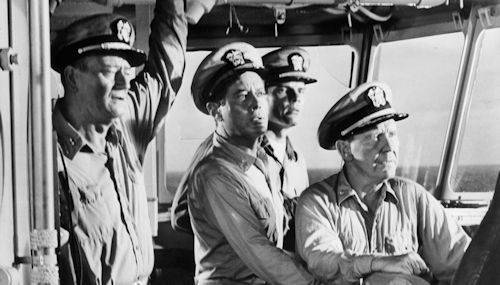
When Rock Torrey is promoted to Rear Admiral, he is given tactical command of Skyhook, a daring mission to rid several Japanese-occupied islands in the South Pacific. The area is overseen by Vice Adm. Broderick, but his overly cautions leadership style is bogging down the objective. Rock's senior officer knows he can't fire Broderick, and he needs the hard-driving, effective Torrey to fix the problem. As the mission begins, Broderick installs a liaison, Cmdr. Neal Owynn, in Torrey's inner circle to keep tabs on activities... and eventually take credit. After an initial briefing, Owynn heads to the island's restroom facilities and is intercepted by Torrey's Captain and Chief of Staff Paul Eddington. After a few choice words and a couple of slaps across the face, Owynn takes the hint and limps back to Adm. Broderick, his spying days over. Famous WWII author and historian Stephen E. Ambrose spoke about good men and chickenshit NCOs. In this film, when it is time to get shit done, the good leaders will creatively neutralize the bad leaders so they can effectively follow their orders. Something subtle you might have missed: models of excellence. The climactic battle with the Japanese fleet was staged using many model ships. These detailed replicas were 1/16th of their real size. They were powered by their own steam and operated by an internal two-man crew who had to peer through slits in the craft's superstructure. Headphones were used for communications. Not everyone liked the models. Star Kirk Douglas felt they did not look authentic enough, even going so far as to offer to re-stage the scenes at his own expense. I personally think they look fine, especially as the battle ensues, and many are blown to bits. Memorable Quotes: "Old Rock of Ages, we've got ourselves another war. A gut bustin', mother-lovin' Navy war." - Cmdr. Paul Eddington, after the attack on Pearl Harbor "... past a certain age, men are apt to avoid making sudden moves where women are concerned. The women have to do the sudden moving, or else everybody stands still until it's too late. It gets late fast in these times. I like this man, and I want him to know it - now." - Nurse Maggie Haynes "All battles are fought by scared men who'd rather be someplace else." - Rear Adm. Rock Torrey
"I wish to have no connection with any ship that does not sail fast, for I intend to go in harm's way." - John Paul Jones Through my many years, I have revisited this John Wayne film many times. I find it incredibly watchable. Though it classified as a war film, the setting of World War II feels more like the backdrop. The real star of In Harm's Way is its attention to its characters (I write that a lot regarding films I love), and the rawness of their stories. These sailors, and those wrapped in their life-orbit, are complex human beings who lead compelling lives. None of it is easy and almost everyone is a bit damaged, even before the war starts. This makes them incredibly interesting. Here are my additional thoughts... This is the only film John Wayne made with prominent, and sometimes controversial director, Otto Preminger. A stern, perfectionist, Preminger made several films that pushed the boundaries of censorship, often covering taboo topics like homosexuality, drug addiction and rape. In the 1940's he gave us the film noir classic Laura (1944). In 1959 he crafted the excellent court drama Anatomy of a Murder (1959). He was also an actor and starred as a German Colonel in Stalag 17 (1953). He even appeared, with his naturally bald head, on the Batman TV series as "Mr Freeze". This film, with is spanning, epic narrative, carries edge for which Preminger was well known. Paul Eddington, though a great naval officer, is a volatile man, who commits a horrible sexual act. It's so bad that his only way out is to subject himself to a solo mission with little chance of survival. Preminger also made the decision to film in black and white. By this time, color films were the new standard. This would be the last big budget all-star effort, the last war film, and the last John Wayne movie, filmed in B&W. For In Harm's Way, it was thought the format would help disguise the use of its model ships, while helping audiences know it was set in during WWII (as opposed to the Korean War). That decision proved to be a wise one. The movie was nominated for the Oscar for Best Cinematography (Black-and-White), crediting cinematographer Loyal Griggs.
There is pain and joy, as we witness the toll taken on the McConnell's, and happy, loving pair who have to deal with deployment and Lieut. McConnell going MIA. The most interesting relationship is between Wayne and Patricia Neal. Both have failed marriages in their past, yet here they meet by chance. They show us that it's never too late to fall in love. At first he shies away from the relationship with nurse Lieut. Maggie Haines, but quickly gives in, sensing that she's a good, strong woman. One of my favorite exchanges is immediately following their reunion at the Pacific base camp, on the eve of battle. Maggie asks him, "Will there be time for us, Rock?" He calmly replies with a burning love in his eyes, "We'll make time, Maggie." Then he kisses her and walks away. It's simple, and powerful. And then there's Kirk Douglas, in the role of Paul Eddington. God, that man can act. As Rock's first officer, his personal life is always a wreck. His wife, a sexy floozy, is cheating on him. She is then killed during the Pearl Harbor attack, and he is demoted when he gets into a bar fight. He eventually returns to command and falls for beautiful young nurse, Annalee Dorn, portrayed by Jill Haworth. What he doesn't know is that she's still in love with Torrey's estranged son, a PT Boat crewman named Jere. At a beach party, Annalee refuses Douglas' advances, telling him she is engaged. He is furious. Well, you can figure it out what happens next. Kirk Douglas can make you love him one minute, then hate him the next (only Jack Nicholson does it better). His role in this film, like many of the men he plays, embodies the unpredictable powder-keg, waiting to go off at the slightest spark. Those are a few of the reasons I love this World War II Navy historical epic. There is one final note to consider. This film does contain references to the Japanese army in terms that are derogatory by today's standards. They are referred to as "Japs" and "Nips". It's the same thing as calling the German soldiers "Krauts" or "Jerrys". These soldiers were the United States' mortal enemies at the time. It was dehumanizing. Japan attacked the US Navy at Pearl Harbor. That catapulted the US into war. It is historically accurate to show that those terms were used by our military. I do appreciate that, here, those terms were sparsely used. tofa On to No. 97... The Water-God Calamity
|


 Defining Moment:
we've got a job to do here...
Defining Moment:
we've got a job to do here... Dad's Review:
 I
know that this film is not considered a romance, but its couples,
and their
relationships, are a huge strength . Most war movies portray
spouses as
simply women the soldier kiss goodbye right before shoving
off for battle. Here, these hardened men of conflict, with all
their glorious imperfections, need the women they love.
I
know that this film is not considered a romance, but its couples,
and their
relationships, are a huge strength . Most war movies portray
spouses as
simply women the soldier kiss goodbye right before shoving
off for battle. Here, these hardened men of conflict, with all
their glorious imperfections, need the women they love.